At Prime Conveyance, your new beginning is our priority. With over 20 years of experience, we offer complete moving services in Thessaloniki, combining safety, consistency and the most competitive prices in the market.

Η transport of exhibition equipment is not like a «simple move»: it has strict loading schedules, limited access to the premises, the need for proper box marking and (often) zero margin for delay. Whether you are involved in an exhibition in Athens (e.g. Metropolitan Expo) or in the Thessaloniki (TIF-HELEXPO), this checklist will help you organise every step with peace of mind and security.
Objective: to get your equipment on time, without damage, with a clear unloading sequence so that the stand can be set up quickly.
Before you close a freight forwarder: the 7 critical facts
- Hours and entry procedure for trucks/van (move-in/move-out, appointments, badges).
- Access points, ramps, freight elevators, maximum height/weight and vehicle restrictions.
- Equipment list with dimensions/weight (e.g. vitrines, TV, lighting, stands, samples).
- Fragile/high value items and need for special packaging (flight cases, boxes, foam).
- Need for a forklift/carrier or workshop on the spot.
- Insurance (what is covered, what is not) and responsibilities at the exhibition site.
- On-site manager with a phone number that will be available at the pickup.
Checklist by time (practical timetable)
6-8 weeks ago
- Finalize pavilion design and needs (furniture, lighting, AV, storage, signage).
- Ask the organisation/venue exhibitor instructions (loading, hours, access, technical rules).
- Build inventory (list) and decide what will go with crates, what with pallets, what «bulk» in protectors.
- Book in time Transfer (ideally with an arrival time window) and, if necessary, lifting.
2-3 weeks ago
- Order materials: cartons, bubble wrap, stretch film, corner protectors, tapes, ties, labels.
- Here you go box codes (e.g. A1-A20) and marking rule: «Pavilion/Zone», «Fragile», «Open first/last».
- Visit function test on AV/electronics and take pictures «before» (helps to check/secure).
- Check who receives and who signs (proof of delivery).
48-72 hours ago
- Pack fragile and close transport boxes/boxes with double tape.
- Put inside each box list of contents (a paper) and on the outside code.
- Prepare «kiosk kit» (scissors, cutters, tapes, multi-purpose tools, binders, markers, cleaners, small tools).
Transfer day (loading)
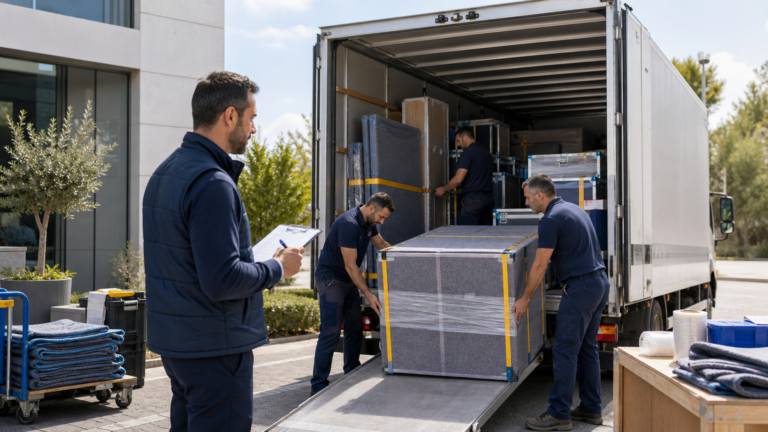
- Load sensibly unloading order: whatever is set up first, be more accessible.
- Keep separate the sensitive (AV, glass, products) and note them in the inventory.
- Request loading photos (in particular pallets/boxes) for documentation.
Tip for exhibitions: The «windows» of arrival are often narrow. Prefer to target earlier arrival and have a plan B for temporary waiting/parking.
On delivery (unloading & setting up)
- The on-site manager must have phone on and a copy of the list.
- Check the boxes/pallets one by one based on the inventory.
- Save to the empty packaging materials organized (you will need them on your return).
- If there is damage, photograph it immediately and note it on the receipt.
After the exhibition (return)
- Visit brief account: what was broken/what was missing/what needs better packaging next time.
- Collect with same code logic and keep separate «to be checked in office» boxes.
- Agree whether it will go directly to headquarters or to temporary storage.
Packaging: how to reduce damage and delays
- Flight cases/transport boxes for AV, lighting, demo units and tools.
- Palettes when you want fast unloading with a pallet truck/lift.
- Forensics in big letters: «Fragile», «Up/Down», «Opens first».
- Double protector (bubble + foam) in corners/sensitive.
When you need a lift or special handling
For heavy exhibits, pallets or bulky booth items, the right equipment greatly increases safety and reduces time. If there is a floor, narrow aisles or access restrictions, let us know ahead of time so a solution can be provided.
See also our service: Lifting machinery.
Indicative services that assist in exhibition transport
- Forward for fast, time-critical deliveries.
- Microtransports for additional equipment/last minute needs.
- Removals for full organisation of equipment/office transport.
Frequently asked questions
When should I book a transfer of exhibition equipment?;
Ideally 3-6 weeks in advance (and earlier for large events), so that you can «lock in» arrival time and organise packing materials, access and any lifting equipment.
What is more practical: boxes or pallets?;
For many small items/promotional material, boxes are practical. For fast loading and better stability, pallets (with stretch & corner protection) often save on time.
How do I reduce damage to AV and fragile?;
With proper packaging (flight cases or hard boxes), double protection in corners and clear marking. Good to have «before» and «after» photos for checking.
What should I have with me on the day of the set-up?;
A kit with cutter/scissors, strips, binders, marker, polymaster, spare parts and basic cleaning supplies. It will save you time from minor problems.
Can Prime Transport help with exhibition transport?;
Yes. We can organise the transport of exhibition equipment with a focus on timing, the correct loading/unloading sequence and packaging to get the stand set up faster.